
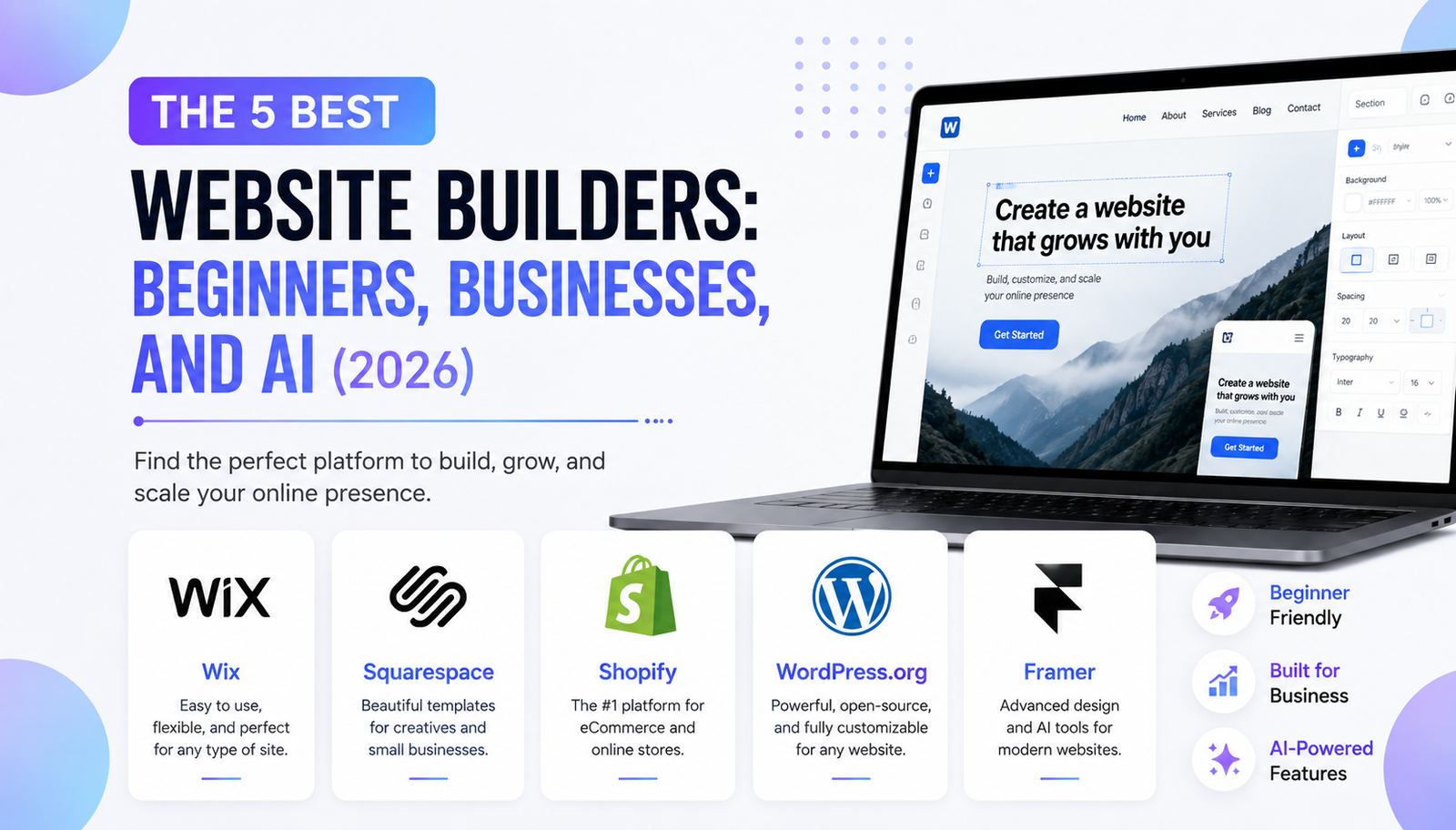
Want to build a website without coding? Discover the best website builders in 2026, categorized for absolute beginners, scaling businesses, and AI-powered generation.
A decade ago, launching a professional website required hiring an expensive developer and waiting months. Today, if you have an idea, you can have a fully functional, stunning website live on the internet in under an hour.
However, the market is flooded with platforms claiming to be the “easiest” or the “most powerful.” Choosing the wrong platform can cost you time, money, and endless frustration. To make your decision effortless, we have categorized the 5 best website builders in 2026 into three distinct groups: Beginners, Scaling Businesses, and the New Frontier of AI.
Category 1: The Best for Beginners (Zero Coding Required)
If you have never built a website before and get a headache just looking at lines of code, these visual drag-and-drop platforms are your best friends.
1. Wix (The Ultimate All-Rounder) Wix remains the undisputed champion of user-friendliness. Its true drag-and-drop editor means if you can use a PowerPoint presentation, you can build a Wix site.
- Best Feature: Absolute creative freedom. You can drag a text box or image literally anywhere on the screen without being locked into a rigid grid.
- Who is it for? Freelancers, local service providers, and absolute beginners who want total design control without touching a single line of code.
2. Squarespace (The Aesthetic Champion) If you want your website to look like it was designed by a high-end luxury agency, Squarespace is the answer. Their award-winning templates are visually stunning straight out of the box.
- Best Feature: Built-in mobile responsiveness. Whatever you design automatically looks perfect on smartphones, which is crucial for modern SEO.
- Who is it for? Photographers, artists, restaurants, and digital creators who prioritize a sleek, modern, and highly visual aesthetic.
Category 2: The Best for Businesses & Scalability
When your website is your main source of income, you need more than just a pretty design. You need robust infrastructure, advanced analytics, and extreme scalability.
3. Shopify (The E-commerce King) If your primary goal is to sell physical or digital products, do not look anywhere else. Shopify is the backbone of the modern e-commerce world.
- Best Feature: The App Store. Whether you need dropshipping integration, email marketing automation, or advanced inventory management, there is a plug-and-play app for it.
- Who is it for? Anyone starting an online store, from basement side-hustles to multi-million dollar international retail brands.
4. WordPress.org (The Ultimate Powerhouse) Wait, isn’t WordPress hard to learn? It has a steeper learning curve, but it currently powers over 40% of the entire internet. It is open-source, meaning you truly own your website and can customize it infinitely.
- Best Feature: Limitless SEO capabilities and plugin architecture. With page builders like Elementor, it becomes just as easy as Wix, but with ten times the power.
- Who is it for? Bloggers, affiliate marketers, and serious business owners who want maximum scalability and complete ownership of their data.
Category 3: The AI-Powered Future
Welcome to 2026, where you do not even need to drag and drop. You just need to know how to type a prompt.
5. Framer (The AI Design Wizard) Framer started as a prototyping tool for UI/UX designers but has evolved into a mind-blowing AI website builder. You simply type a description of the website you want (e.g., “A dark-themed portfolio for a 3D animator”), and Framer’s AI generates the layout, color palette, and initial copy in seconds.
- Best Feature: The AI generation mixed with professional-grade animation tools. It creates sites that look insanely dynamic and interactive.
- Who is it for? Tech-savvy users, startup founders, and designers who want cutting-edge, fast-loading, and visually unique websites generated in record time.
Final Thoughts: Which Builder is Right for You?
Your choice depends entirely on your end goal. If you want a quick portfolio, go with Squarespace. If you are opening an online store, Shopify is mandatory. If you want maximum long-term control for a blog or business, learn WordPress. And if you want to experience the future of web design, give Framer’s AI a try. Pick a platform, claim your domain, and start building your digital empire today.