
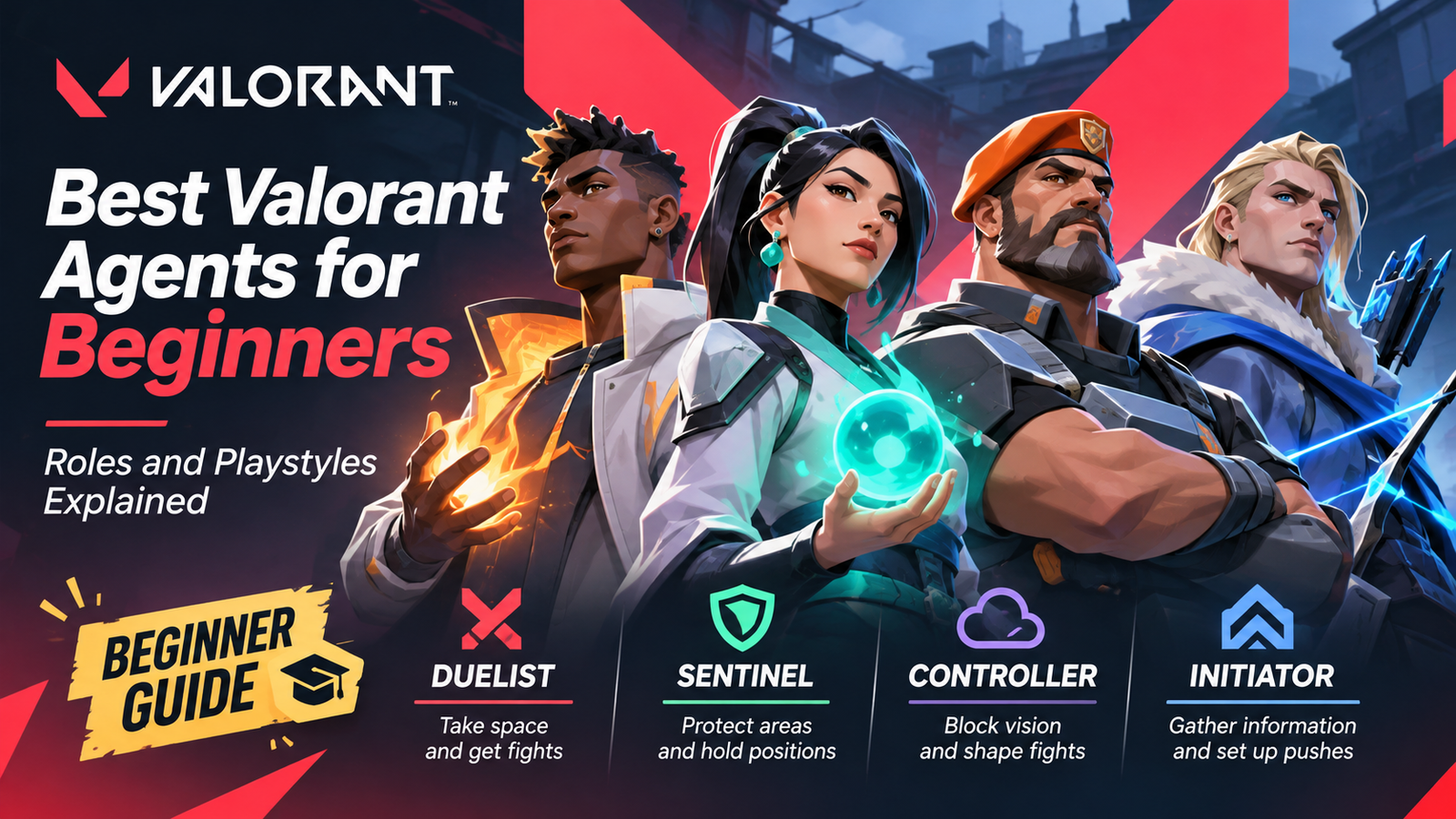
Choose your first Valorant agent to learn useful habits, not copy professional players. Abilities create different responsibilities. Some open fights, others protect territory, block vision, or reveal defenders. Understanding those jobs makes the game easier to read and helps you contribute even when your aim is inconsistent.
Phoenix, Sage, Brimstone, and Sova each teach a distinct role without complicated movement combinations. The best choice ultimately depends on how you prefer to approach a round.
Understanding Valorant’s Four Agent Roles
Duelists take space and initiate direct fights. They need support, but they should not wait behind their entire team during an attack.
Sentinels protect vulnerable areas, discourage pushes, and help teammates hold positions. Their value often comes from delaying opponents rather than chasing kills.
Controllers block important sightlines and shape where engagements happen. Good smoke placement can turn an exposed entrance into a manageable approach.
Initiators gather information or disrupt defenders so teammates can advance. Their abilities are strongest when someone is ready to act on the information.
Roles describe priorities, not rigid rules. A Sentinel still needs to shoot accurately, and a Duelist must communicate. Balanced compositions let players contribute complementary abilities.
Beginner Agent Comparison
| Role | Recommended starter | Alternative to explore | Main lesson | Common mistake |
|---|---|---|---|---|
| Duelist | Phoenix | Reyna | Entering with teammates | Flashing allies |
| Sentinel | Sage | Killjoy | Delaying and protecting | Leaving utility unattended |
| Controller | Brimstone | Clove | Blocking enemy vision | Smoking teammate approaches |
| Initiator | Sova | Gekko | Gathering actionable information | Scouting without follow-up |
These are learning recommendations, not a competitive tier list. Map geometry and personal comfort can change your choice.
Duelist: Phoenix Teaches Confident Entry
Phoenix suits beginners who enjoy aggressive play but need a straightforward way to practice entering contested areas. His Curveball creates a brief opening by blinding players who look toward it. His fire abilities influence space, while Run It Back lets him attempt a dangerous engagement with a return point.
What to practice with Phoenix
Before using Curveball, identify where your teammate is standing. Throw the flash around a corner, then move with its timing instead of waiting until defenders recover. Tell teammates when you intend to push. If you secure an opening, continue into useful space rather than retreating automatically.
On defense, avoid treating every round as permission to rush. Holding a favorable angle and saving utility for a retake can be more valuable.
Alternative: Reyna. Her kit rewards winning individual fights, making her appealing for players practicing aim. However, relying on eliminations for some of her strongest effects means she teaches less about supporting a team when shots are not landing. Jett offers mobility but demands additional movement control.
Sentinel: Sage Makes Defensive Decisions Clear
Sage is a practical introduction to supporting teammates. Her Barrier Orb can obstruct a route, Slow Orb makes an approach harder to cross, and her healing and resurrection abilities help preserve team strength. None of those tools removes the need to understand positioning.
What to practice with Sage
Place a wall to achieve a specific objective: delay a push, protect a plant, or cover a vulnerable angle. A wall used without considering teammate movement may trap allies or surrender useful space. Listen for contact before committing every defensive ability.
When someone requests healing, check whether reaching them exposes you to an opponent. Surviving with available utility can be more helpful than attempting an unsafe rescue. Likewise, resurrection should follow a safety check, not an automatic button press.
Alternative: Killjoy. Her Alarmbot and other devices reward thoughtful setups and awareness of unattended routes. She is worth learning once you understand where attackers commonly enter. Her utility requires more preparation, so beginners should avoid copying placements without understanding their purpose.
Controller: Brimstone Builds Map Awareness
Brimstone is a strong first Controller because his tactical interface makes selecting smoke locations direct. His Sky Smoke blocks enemy vision, Incendiary can discourage movement through an area, and Stim Beacon supports nearby allies. His ultimate can punish opponents holding predictable positions.
What to practice with Brimstone
Start with one simple question: which defender sightline prevents my team from entering? Smoke that angle shortly before the push. Avoid placing a smoke so far forward that opponents can emerge from it unexpectedly onto your teammates.
On defense, preserve enough utility to respond to actual pressure. Smoking an entrance immediately every round can waste coverage if opponents attack elsewhere. Watch the minimap, listen to callouts, and coordinate your timing.
Alternative: Clove. Clove can place vision blocking clouds even after death, which allows continued contribution. That feature does not make reckless peeking harmless: badly positioned clouds can still disadvantage teammates. Learn basic smoke geometry with Brimstone before experimenting with Clove’s more aggressive rhythm.
Initiator: Sova Rewards Information and Timing
Sova helps beginners understand that knowing an enemy’s position is only useful when the team can respond. Recon Bolt reveals visible enemies in its detection area, while Shock Bolt threatens opponents holding common locations. His scouting drone can check dangerous ground before a teammate commits.
What to practice with Sova
Begin with basic Recon Bolt placements that scan likely defender positions. You do not need elaborate trick arrows to provide value. Because opponents can destroy the bolt, vary your timing and avoid treating a scan without detections as proof that an area is empty.
Call out what your utility actually confirms. Saying “two spotted near the entrance” is more helpful than claiming the entire site is clear. Follow information with a coordinated peek, smoke, or rotation.
Alternative: Gekko. Wingman can seek opponents and can plant or defuse the Spike under appropriate conditions. Gekko’s creatures offer approachable utility, but recovering them safely and coordinating Spike actions introduce additional decisions. Practice collecting creatures only when the surrounding area is secure.
Which Valorant Role Fits Your Playstyle?
Choose Duelist if you enjoy initiating fights, making quick decisions, and accepting responsibility for opening space. Pick Sentinel if you prefer defending positions, watching flanks, and anticipating enemy routes.
Choose Controller if you enjoy planning routes and helping the team cross dangerous sightlines. Try Initiator if you like investigating angles, communicating discoveries, and setting up teammates.
Unsure? Try each starter over several matches. Record which decisions felt natural, not merely which agent produced the highest kill count. A comfortable role encourages better decisions under pressure.
Five Habits That Matter More Than Agent Choice
- Stop before shooting. Moving while firing generally reduces rifle accuracy. Practice positioning your crosshair at likely head height before exposing yourself.
- Trade teammates. Follow an entry player closely enough to challenge the opponent who eliminates them, without standing directly in the same line of fire.
- Spend utility with a purpose. Before pressing an ability, decide whether it gathers information, blocks vision, delays enemies, or enables a fight.
- Share short callouts. Communicate confirmed locations and meaningful ability use. When voice chat is uncomfortable, use pings and available communication tools.
- Review one mistake. After each match, identify a repeatable error, such as smoking too late or flashing a teammate, and target it next time.
These habits transfer across agents.
A Simple Practice Plan for Your First Week
Start in the Practice Range with your chosen agent. Test every ability, note its direction and activation method, and practice switching back to your weapon afterward. Then use casual matches to focus on a single role responsibility rather than your scoreboard position.
For Phoenix, coordinate one flash and entry. For Sage, delay an attack without immediately surrendering your position. For Brimstone, identify the sightline your smoke removed. For Sova, communicate one confirmed scan result and act with a teammate.
After each session, answer two questions: Did my ability create a useful advantage? Did I survive or trade long enough to capitalize on it? These answers make progress easier to assess.
Frequently Asked Questions
What is the easiest Valorant agent for a complete beginner?
Sage is often approachable for players who prefer defensive decisions, while Phoenix suits newcomers who want to practice fighting. Brimstone and Sova offer clear ways to learn team utility. Ease depends on your habits, not a universal ranking.
Should beginners avoid Duelists?
No. Playing Duelist teaches entry timing and confidence. Just remember that initiating fights is not the same as pushing alone. Communicate your plan and give teammates a chance to follow.
Is a healer required in every Valorant team?
No. Teams do not need a dedicated healer to function. Sage’s healing is useful, but controlling vision, collecting information, and taking coordinated space are equally important team functions.
Should I learn several agents immediately?
Learn one main agent and one backup first. Once you can use their abilities without constantly thinking about the buttons, try a different role. Early familiarity beats constant switching.
Conclusion
The best Valorant agents for beginners are those that teach repeatable decisions. Phoenix develops entry timing, Sage rewards defensive judgment, Brimstone teaches smoke placement, and Sova builds information discipline. Choose the role that matches your instincts, practice purposeful utility, and expand your agent pool after the fundamentals become comfortable.