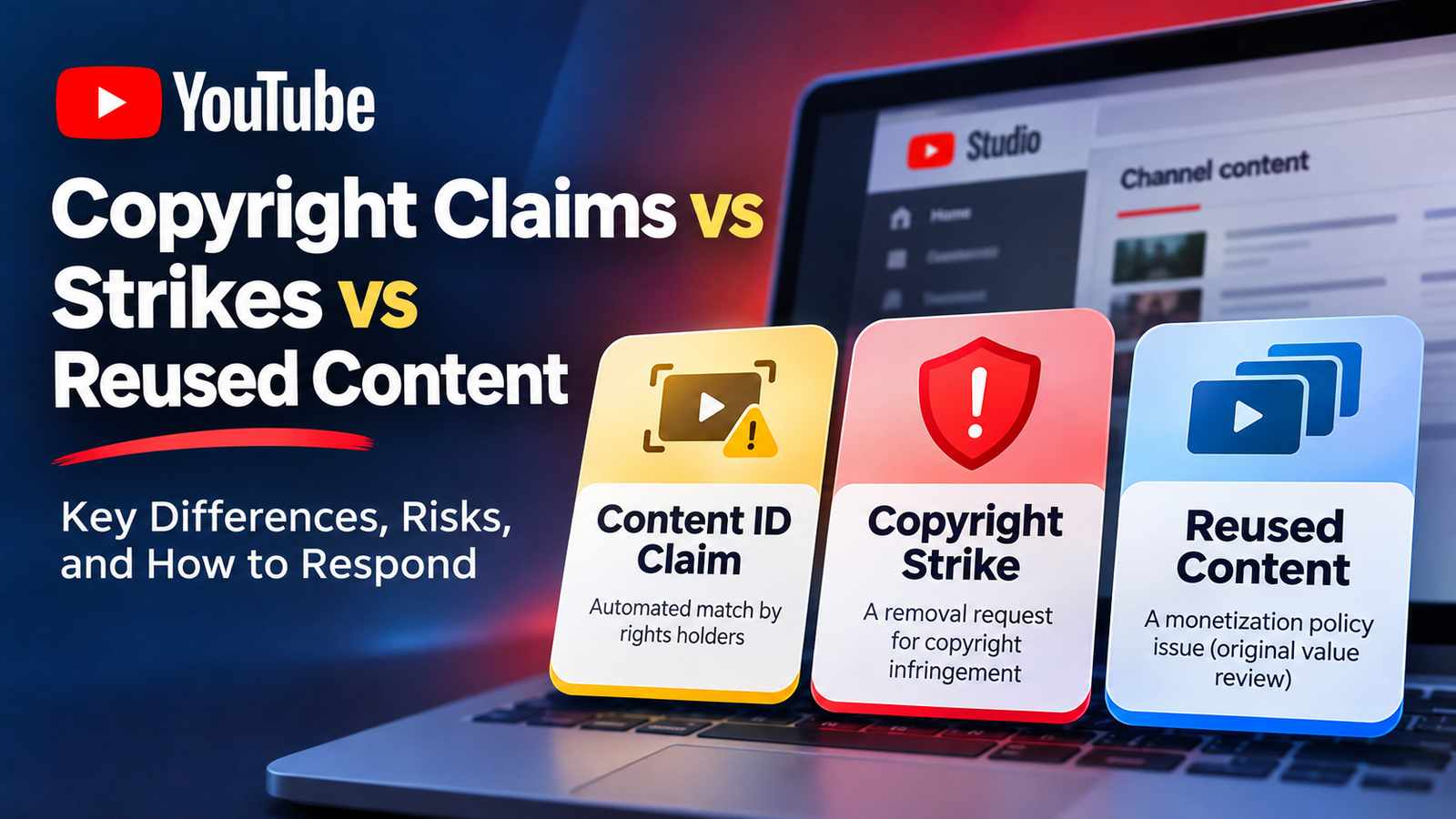
Uploading someone else’s music, footage, or clips can trigger three different problems on YouTube: a Content ID claim, a copyright strike, or a reused content monetization decision. These are not interchangeable warnings. Each follows different rules, affects your channel differently, and requires a different response.
The distinction matters especially for reaction channels, gaming creators, compilation editors, and Shorts publishers. A video can remain online despite a copyright claim, disappear after a takedown, or earn no money even without any copyright complaint. Understanding which system applies prevents unnecessary disputes and costly channel decisions.
The Three Systems Compared
| Question | Content ID claim | Copyright strike | Reused content |
|---|---|---|---|
| Who initiates it? | Rights holder through automated matching | Rights holder through a legal removal request | YouTube during monetization review |
| What is assessed? | Matching protected audio or video | Alleged copyright infringement | Original value across channel content |
| Immediate result | Video may be tracked, monetized, or blocked | Video removed after valid takedown | Monetization may be denied or removed |
| Does it create a strike? | Not normally | Yes | No copyright strike by itself |
| Can permission solve it? | Licensing may support a dispute | Authorization may support a counter notification | Permission alone is insufficient |
| Best first action | Inspect claim details | Read takedown notice immediately | Review production process and channel patterns |
This comparison reflects YouTube’s separate copyright enforcement and Partner Program rules. One video can face multiple systems simultaneously.
What Is a YouTube Content ID Claim?
Content ID is YouTube’s automated matching technology. Participating copyright owners provide reference files, and YouTube scans uploads for matching audio or visual material. A match can produce a claim even when only part of a video contains protected content.
The owner generally chooses whether to monetize, track, or block the matching video. Restrictions may vary by country. A creator might therefore see a video available in one region but unavailable elsewhere.
For videos longer than three minutes, a monetized or tracked claim generally allows continued viewing. However, Shorts between one and three minutes with an active Content ID claim are blocked, regardless of the claimant’s selected policy. This distinction is particularly important when repurposing longer clips as Shorts.
A claim usually affects the specific video rather than channel standing. Nevertheless, advertising revenue may go to the claimant, or eligible creators may have revenue sharing arrangements. Seeing advertisements does not establish that the uploader receives the income.
How to Respond to a Claim
Open YouTube Studio, select Content, locate the affected upload, and inspect Restrictions and the claim details. Confirm which material was identified, who claimed it, and whether the video is blocked or monetized.
If the claim is valid, you may leave it in place. Alternatively, YouTube Studio may let you trim the segment, replace claimed music, or erase the song. Successfully removing all claimed material can clear the claim without reuploading. Since June 2025, saved Studio Editor changes cannot be reverted to the original version, so retain a backup first.
Dispute only when you have a defensible basis, such as sufficient rights, misidentification, or an applicable copyright exception. Credit, a purchased song copy, and choosing not to monetize are not sufficient grounds.
What Is a YouTube Copyright Strike?
A copyright strike follows a copyright removal request that YouTube determines appears valid. Unlike a routine Content ID claim, it involves removing the reported video. YouTube sends a notification explaining the action and available options.
YouTube states that copyright strikes expire after 90 days when Copyright School is completed and the channel has fewer than three strikes. Three copyright strikes within 90 days make the channel and associated channels subject to termination. This is a serious account risk, not merely a revenue restriction.
Creators may resolve a strike through expiration, a retraction from the claimant, or a valid counter notification. Counter notifications are legal submissions, not ordinary customer service appeals. Use one only after reviewing the legal basis and consequences.
Deleting an already removed video does not eliminate its strike. An exception exists when YouTube provides a scheduled removal warning: deleting the content within the stated seven day window can prevent the strike. Check the actual notification before acting.
What Counts as Reused Content?
Reused content is a YouTube Partner Program eligibility issue, not a copyright claim. YouTube examines whether a channel repackages existing online material without meaningful commentary, substantive editing, or educational or entertainment value. Reviewers may examine videos, titles, descriptions, the channel theme, and the uploads generating substantial watch time.
Crucially, having permission to use footage does not automatically satisfy this monetization policy. Conversely, a heavily analyzed clip might satisfy the reused content standard while still requiring copyright permission or a valid exception. Copyright compliance and monetization eligibility must be evaluated separately.
YouTube identifies critical reviews, narrated sports analysis, meaningful reaction commentary, and substantially edited footage with an original storyline as potentially eligible examples. Compilations of social media clips, minimally altered television scenes, and reused videos with almost no narrative are examples that may violate the policy.
Reused Content vs Inauthentic Content
These policies are related but distinct. On July 15, 2025, YouTube renamed its repetitious content policy to inauthentic content, clarifying restrictions on repetitive or mass produced uploads. The platform explicitly stated that its separate reused content policy did not change.
A channel posting original but nearly identical template videos may face inauthentic content concerns. A channel stitching together other creators’ footage with negligible additions may face reused content concerns. Both can affect monetization without creating copyright strikes.
Examples: Which Rule Applies?
| Creator scenario | Likely issue | Practical interpretation |
|---|---|---|
| Gameplay with licensed music claimed by Content ID | Claim | Check license scope and claim details |
| Movie scene uploaded after a valid takedown request | Strike | Explore retraction or lawful counter notification |
| Viral clips stitched together without explanation | Reused content | Added transitions alone may not establish originality |
| Sports footage with detailed tactical narration | Possible copyright and monetization review | Commentary may help eligibility, not guarantee rights |
| Dozens of nearly identical scripted Shorts | Inauthentic content | Original footage alone may not resolve repetition |
These are illustrations, not automatic verdicts. Context, actual rights, editorial contribution, and channel wide patterns determine outcomes.
A Practical Decision Process
First, identify the notification rather than assuming every restriction is a strike. A Content ID claim should direct you toward the particular audio or video match. A takedown notice demands urgent review because your upload has been removed. A monetization rejection requires examining how the channel creates value.
Second, document your rights and production process. Keep music licenses, permission emails, original recordings, scripts, editing timelines, and raw footage where appropriate. These records help substantiate disputes and demonstrate creative contribution, although evidence alone does not guarantee approval.
Third, choose the correct remedy. For a valid claim, consider replacing music. For an erroneous claim, use the dispute procedure; the claimant normally has 30 days to respond, and a subsequent appeal generally allows seven days. Escalation can lead to a legal removal request and strike, so do not dispute reflexively.
For reused content decisions, assess the whole channel rather than changing one thumbnail. If YouTube offers a Partner Program appeal, follow the deadline displayed in Studio. YouTube advises against deleting videos before an appeal because reviewers assess the channel in its current state.
For scheduled Partner Program suspensions, YouTube may offer seven days to appeal before suspension. After an eligible suspension, the appeal window is generally 21 days. YouTube says appeal decisions normally arrive within 14 days; rejected creators may reapply after 90 days. Always rely on the precise dates displayed in your own YouTube Studio account.
Frequently Asked Questions
Can I monetize videos that have Content ID claims?
Sometimes. A claim may redirect revenue to the rights holder, permit revenue sharing in eligible situations, or block viewing. Check the exact policy rather than assuming every claimed video is ineligible.
Does a copyright claim hurt my entire channel?
Usually not directly. YouTube says claims generally affect individual videos. A separate monetization review can still identify broader channel problems, however.
Is adding subtitles or changing playback speed enough?
Not necessarily. Cosmetic changes do not establish meaningful editorial value. YouTube specifically identifies minimally altered material and songs changed only in pitch or speed as problematic monetization examples.
Does fair use automatically prevent strikes?
No. Fair use depends on applicable law and circumstances. Content ID cannot reliably determine legal exceptions, and a rights holder may still pursue removal. Consider qualified legal advice for consequential disputes.
Can reused content cause channel termination?
Reused content chiefly concerns Partner Program eligibility, potentially removing channel monetization. Copyright termination follows a different process involving strikes. Avoid confusing loss of earnings with account termination.
Conclusion
Treat these systems as three separate questions: Who owns the material? Has a legal removal occurred? Does the channel add enough original value to qualify for monetization? A claim concerns matching content, a strike concerns copyright takedown enforcement, and reused content concerns monetization standards. Check the precise notice, preserve evidence, and respond through the appropriate process instead of applying one solution to every problem.
Sources and References
- YouTube Help: Learn about copyright claims
- YouTube Help: How Content ID works
- YouTube Help: Understand copyright strikes
- YouTube Help: Dispute a copyright claim
- YouTube Help: Remove copyright-claimed content from videos
- YouTube Help: YouTube channel monetization policies
- YouTube Help: Appeal a YouTube Partner Program suspension or application rejection